


Hi there.
Welcome to the 130 new subscribers who joined Marketing For Geeks since the last issue. Big thanks to everyone who shares MFG with their network. P.S. When you refer friends, you get access to my top templates (including my email audit & marketing plan template).
Every month, I share 1 interesting thing, 3 actionable marketing insights that have helped me do better product marketing, and 5 pieces of marketing that caught my eye.
ICYMI: In my last issue, I spoke with Olamide Adurota of Risevest about how Rise manages experiments to move users along the funnel.

In today’s issue, I write about why your value prop probably isn't different from competitors (and how to fix that), creating an objection-smasher page, and the 10-step checklist for content marketers in a new role.
Let's dive in!
🔑1 Interesting Thing
A couple of weeks ago, I made a video geeking out about Less Annoying CRM’s website; it’s hands down the best use of a value prop I’ve seen on a website yet. [P.S. Subscribe to Marketing For Geek’s YouTube channel]
Today, I want to dive deeper into how to define your value proposition; and why most websites have it wrong.
There are 2 approaches to value prop messaging:
Approach #1: Why You Should Use A Product Like Ours
This is the approach most companies take. It simply states why people use tools within that category. Let’s take Calendly as a case study. Calendly’s hero section offers the exact same value props you can find in any other meeting scheduling tool. Because it tells you why you should use a meeting scheduling tool; not why you should use Calendly specifically.
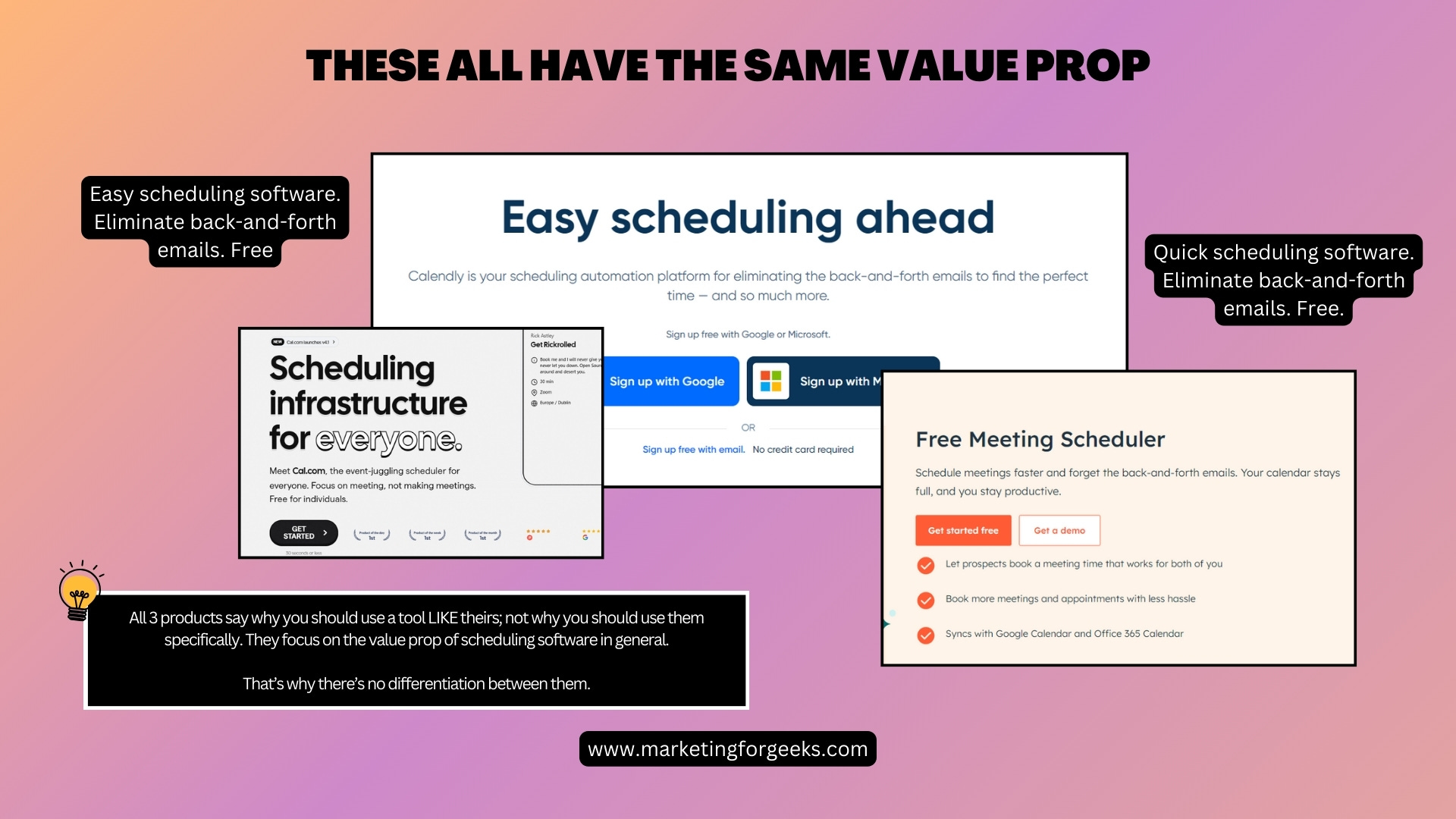
The problem with this approach is that it doesn’t differentiate you from competitors. It leaves you promising customers the exact same thing that others are promising them.
This doesn’t mean it’s not an important value prop approach to document or that you should never use it. But it should not be your main value prop unless you’re selling an innovative product with no known competitors (which is very rare and not the case for most products). It is most useful for TOFU marketing (e.g. SEO).
So, how do you define this type of value prop?
Conduct audience research: Audience research can never be over-done. Dive deep into understanding who your target audience is. Conduct discovery interviews (here’s a sample) to better understand them. Make sure to document all the research you do.
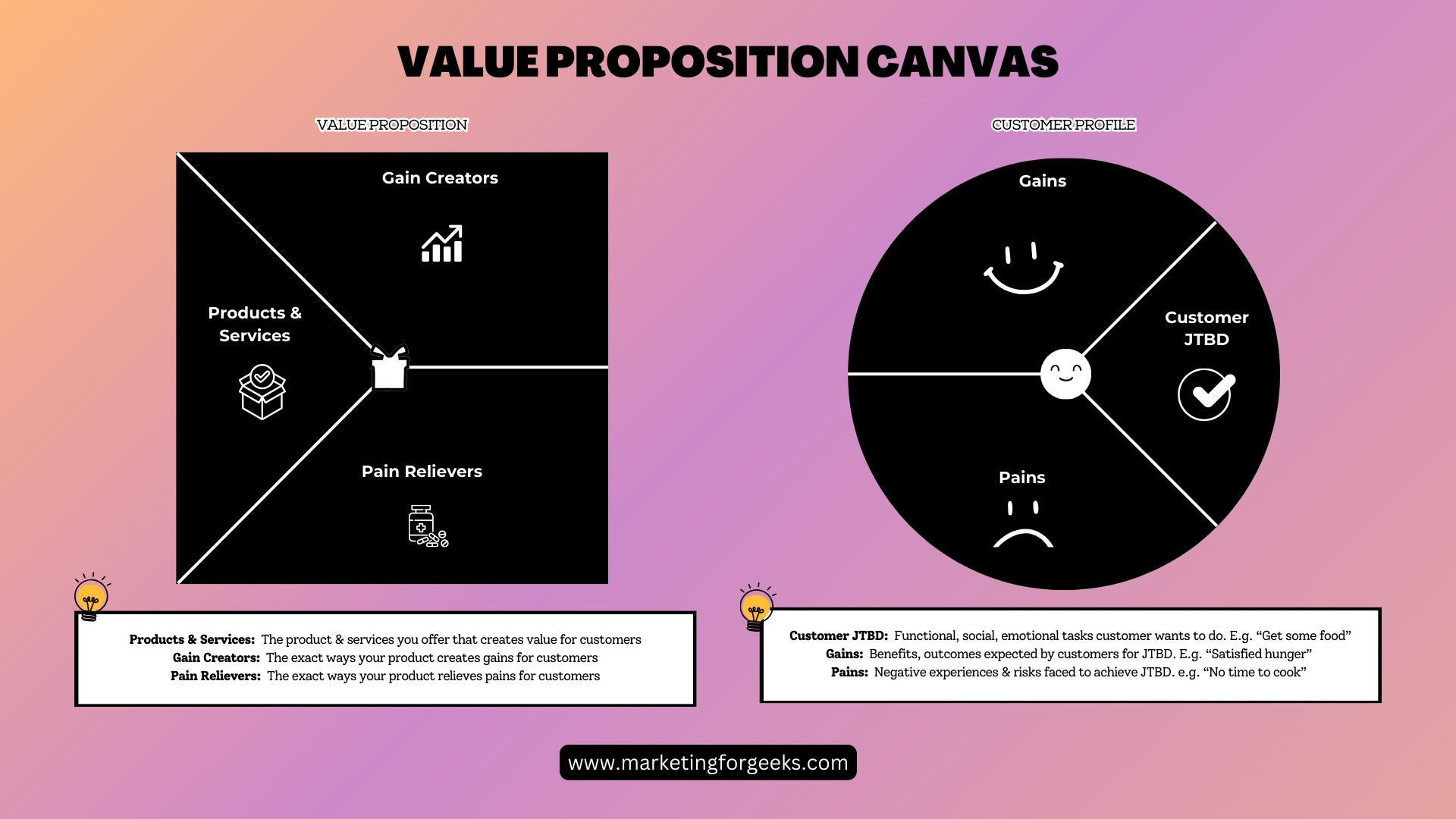
Define their JTBD: Users “hire” your product to do a “job” for them; the Job-To-Be-Done (JTBD) framework helps you define what that job is. The way a job gets done might change, but the job itself doesn’t. For example, a person might want to get from their home to work; that’s a job. They could achieve that in different ways; taking public transport, booking an Uber, hitching a ride, driving their own car, or even walking. Your promise is to help them achieve that “job” more effectively or efficiently.
Map their pains & gains: Now that you understand your audience, list the problems (aka pains) they face while trying to achieve their JTBD and the motivation & positive outcomes (aka gains) they expect from achieving it.
For example, for the “get from home to work” JTBD, the pains might be road traffic, cost of fuel, and discomfort during transit. The gains might be getting to work on time, minimising commuting costs, and enjoying a stress-free commute.
You can use tools like the Value Proposition Canvas pictured above (specifically the customer profile section) to map out their needs and pains.Map your solution: Once you’ve mapped your customer profile, outline how your product or service creates gains and relieves pains. Again, the Value Proposition Canvas can help here, specifically the value map section.
Combine them into benefits: Take the problems and the solutions that you’ve mapped and combine them into benefits for the customer. Make sure to twist the knife on their problem and be specific about how you solve it.
Approach #2: Why You Should Use Our Product Specifically
This is the approach that Less Annoying CRM used. Here, you make a promise that is unique to you. It says what you offer that competitors do not. Let’s go back to the Calendly examples. Here are some Calendly alternatives that DO show why you should choose them specifically.
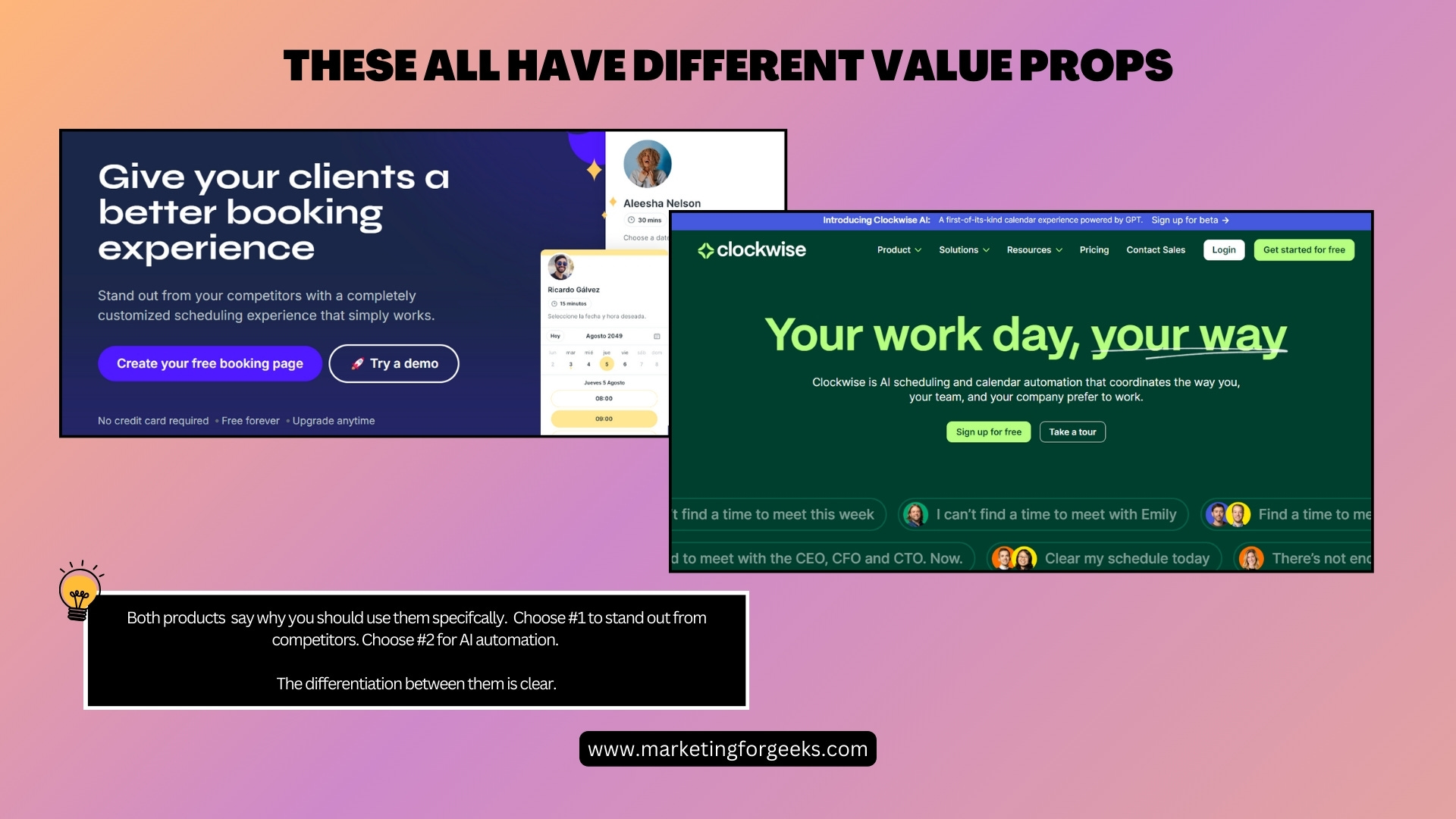
If you’re in a red ocean market where people are aware that competitors exist, this is the perfect option. Use this value prop type in your hero section and on comparison pages. It’s perfect for BOFU marketing.
To define this kind of value prop, you need to have followed the steps in approach #1. Once those are completed, you can move on to these steps:
Conduct a ton of competitor research: Dive deep into your competitors, the solutions they offer, and what customers think about them. You can use my competitor research template [🔒SUBSCRIBE TO GAIN ACCESS] to help.
Explain how your solutions differ from competitor solutions: What do you do differently than they do? Think on every single level you can. What’s their team size like? Do they take a different approach than you do? Where’s their HQ? What’s the UX like? List as many differences as you possibly can, whether you consider them relevant or not.
Connect the differentiation to your TA’s problem: How is that differentiation of benefit to your TA? You can turn even the most subtle differentiators into value props. Here are some examples:
Global competitors? Turn your local focus and understanding of nuance into strengths.
Competitors with VC backing? Say that unlike competitors, you can prioritise users over investors.
Larger competitors? Say that while you don’t have their resources, you’re more agile and able to make changes without bureaucracy.
Sample Value Proposition Levers
If you’re still not sure what makes your product different from competitors, here are a few unique positioning levers you can use:
We’re #1: Highlight your market leadership.
We Have The Best Quality: Emphasize your high standards and craftsmanship. Best used when you’re higher priced.
We’re Only For A Few People: Position your product as an exclusive club that only the best can get into.
We Came First: Emphasize your pioneering status. Use your years of experience as a strength.
We Fixed This Competitor Screwup: Position competitors as an enemy you’ve come to save the customer from. Focus on the problems users face with them.
We Care More About You: Focus on customer-centric values and personalised service.
We Are Cheaper: Stress affordability. Emphasize the cost savings.
We Focus on One Thing Alone: Differentiate with a niche focus and highlight expertise within that niche.
We’re the 2nd Best, and That’s Okay: Show humility and reliability.
TL;DR (Too Long, Didn’t Read): You can’t stand out from competitors with generic value props like “Save time on xxx." Competitors can make that same promise. Focus on a promise that only you can make.
📣Tweet this.
💭3 Insights
#1. Use review sites for user & competitor research.
When you’re trying to understand more about competitors (and why users should choose you over them), review sites are the best place to start.
Go to the app store pages of competitors or check out review sites like G2 & Capterra. Read as many reviews as you can, from the 5-star reviews to the 1-star reviews. You can find out what people love the most about your competitors, as well as what things frustrates them the most about them.
P.S. This can help you find your differentiation as well. Look at what your competitors are getting wrong and then promise users that you’d get them right.
If the top complaint from users is their customer service, then emphasize your commitment to customers and leverage that as a value prop (e.g. “We respond 3 times faster than competitors” “Speak to a real human and not a bot” “The only xxx that actually cares about customers”)
TL;DR: Use review sites like G2 and Capterra for competitor research. Read all reviews to identify what users love and hate. Use these insights to highlight your strength over competitors.
📣Tweet this.
#2. Create an objection smasher page.
Insight by Dave Gerhardt, CEO at ExitFive. This insight (Insight #2) is written in his voice.
Here’s one of my favourite B2B SaaS marketing plays you can steal. It’s called “The Objection Smasher.”
Create a public-facing landing page and list out the brutally honest 5-10 reasons customers don’t buy your product and why they churn.
Every buyer is working through 2-3 vendors and hundreds of features. But they all know they are being sold to. Of course, everything you say about your product is going to be glowing. That’s what everyone else is doing.
You can shift the conversation and earn trust and credibility by sharing the top reasons people don’t buy. You’d have a better chance by sharing your POV on the reasons why people don’t buy. That way, you control the message, rather than having them wonder and maybe never even talk to you.
If you handle the objections upfront before you even get to a sales call, your sales team doesn’t have to play defence right from the first call.
Sit down with your sales, customer success, and product leaders. Take insights from each team and handle those objections in advance. This could easily start with a blog post.
TL;DR: Create an "Objection Smasher" page. List the top reasons customers don’t buy and address them honestly. This builds trust and handles objections upfront, making sales calls smoother and more effective.
📣Tweet this.
#3. Don’t jump right into creating when you start a new job.
Insight by Jeremiah Ajayi, Content Marketing Manager at RemotePass. This insight (Insight #3) is written in his voice.
When I started as Content Marketing Manager at RemotePass, I didn't jump straight into content creation.
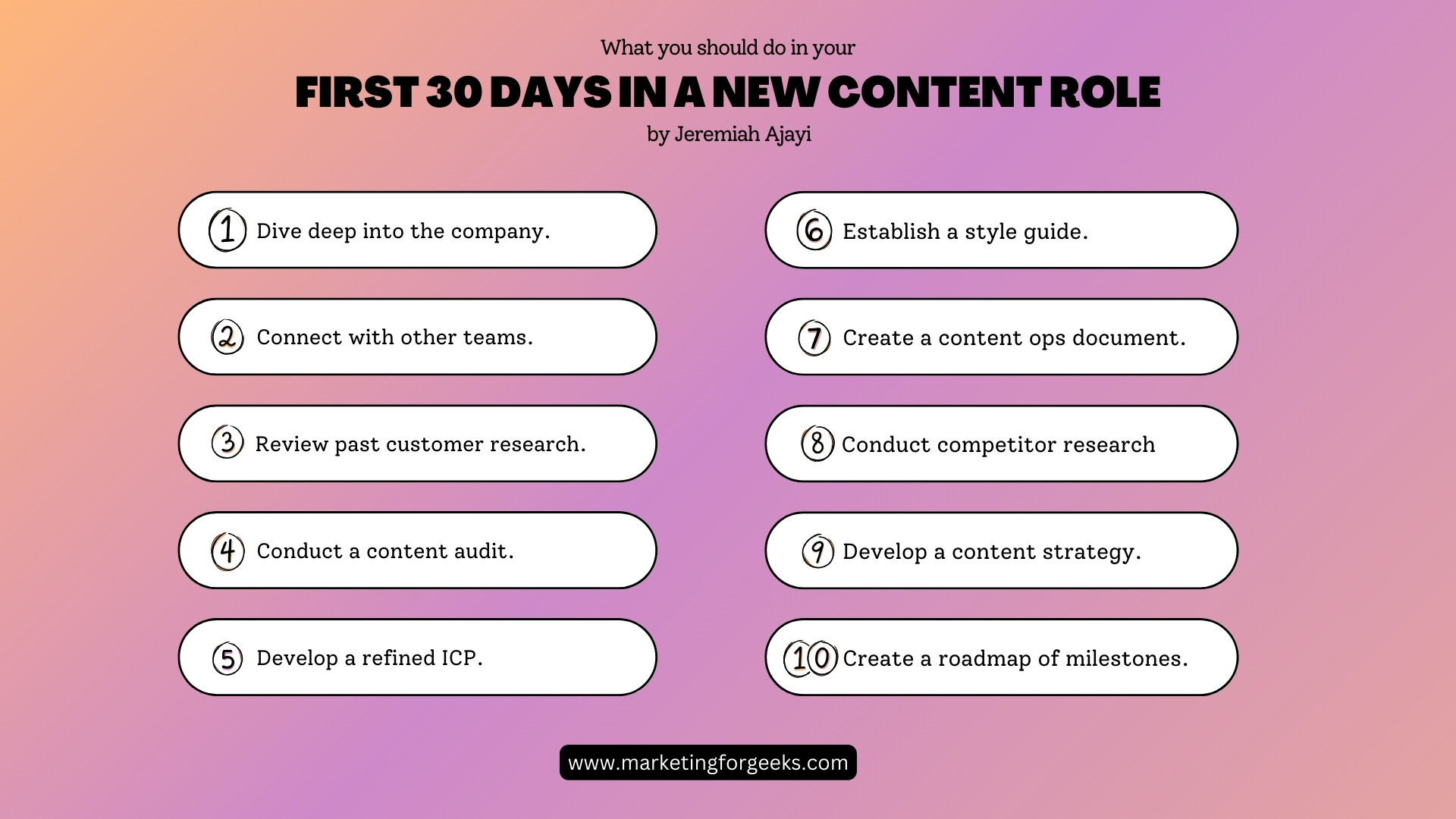
Instead, I spent my first month focusing on building a strong foundation. Here’s my 10-step guide to what you should do in your 1st month as a content marketing manager:
Deep Dive: I familiarised myself with the company, our product, and value proposition.
Building Bridges: I connected with other teams, especially Growth, Sales, and Customer Success, to understand their perspectives.
Learning From The Past: I reviewed past demos and customer calls to gain insights into customer needs and pain points.
Content Audit: I conducted a content audit to assess existing content and identify areas for improvement.
Sharpening The Focus: I collaborated with the Sales team to develop a more refined Ideal Customer Profile (ICP) based on my customer understanding.
Speaking The Same Language: I established a style guide to ensure clear and consistent communication across all marketing materials.
Planning For Success: I created a content operations document outlining content cadence and publishing schedules.
Knowing The Competition: I conducted competitor research to identify any gaps in our content strategy.
Data-Driven Approach: Based on the content audit and competitor research, I developed a data-driven content strategy to address the gaps I identified.
Setting The Course: I created a roadmap of milestones for the rest of the quarter and aligned them with the executive team.
Doing these set me up for a successful second month where I've already been able to achieve tangible results.
NOTE FROM LADE:
This framework can easily apply to any other role. Just replace the word “content” with your niche. E.g. if you’re a growth marketer, go an audit of the current growth efforts, create a growth ops document, and develop a growth strategy.
TL;DR: Don’t go into creation mode immediately at a new job. Spend the first month laying a strong foundation with this 10-step checklist (by @jeremiahajayi_):
📣Tweet this.
⚡5 Pieces of Marketing
Since I spent most of this issue discussing value props, the 5 pieces of marketing will focus on products with clear differentiation in their messaging.
#1. Bang & Olufsen’s Ads👍🏽
Bang & Olufsen position themselves as being exclusive. Their value prop is their exclusivity; making you feel like you’re part of an elite few when you own one.


#2. Avis Rental’s “We Try Harder” Campaign👍🏽
Avis Rentals had always trailed behind the market leader in car rentals. Rather than pretending to be the No. 1 car rental company, they leaned on their #2 position as their value prop, birthing the iconic “We Try Harder” campaign.


#3. Basecamp’s Small Business Manifesto👍🏽
Basecamp does an excellent job emphasizing their commitment to small businesses. That’s why they use their personalised services and small size as a value proposition.


#4. Southwest Airlines’ Transfarency Promise👍🏽
At a time when other airlines used sneaky pricing (with people complaining about hidden fees), Southwest Airlines positioned itself as the airline that was fully transparent about its pricing with no hidden fees.


#5. Hey’s Website Hero Section👍🏽
Hey was built by the same people who built Basecamp, so their strong value prop is no surprise. They position themselves as the hero coming to save you from shitty competitors.

What I’m Reading
8 Top Marketing Newsletters in Nigeria — I made a list of some of my favourite marketing newsletters authored by Nigerians.
Demand generation for long sales cycle — Anyone who works in B2B can attest to the long sales articles; this article tells you how to do demand generation right.
The MKT1 Guide to positioning — How to differentiate your product, without getting stuck in the weeds.
How Calendly overhauled their product-led sales motion — Calendly’s CMO shares a first-hand account of how Calendly fixed their lead routing problem.
Pricing & Packaging for SaaS 🏷️ — A great guide to SaaS pricing strategies & models + examples.
Did you enjoy this issue? Give it a ❤️ and let me know in the comments section.
Even better, share this with someone and you can get access to more free templates from me.
This is Crazy Good. Thank you Lade. I agree on allowing yourself a month to settle in but some managers might not allow that. However I love the article, Well done!