

Hi there. Long time, no see.
This is my first newsletter in over a year, happy to be back. I took the break because I was struggling with my mental health, got diagnosed with ADHD, and found it really hard to give any attention to Marketing For Geeks. I’m in a much better place now, and I’ll write about it properly another time.
Anyway, in August, I joined Daya as their first marketer.
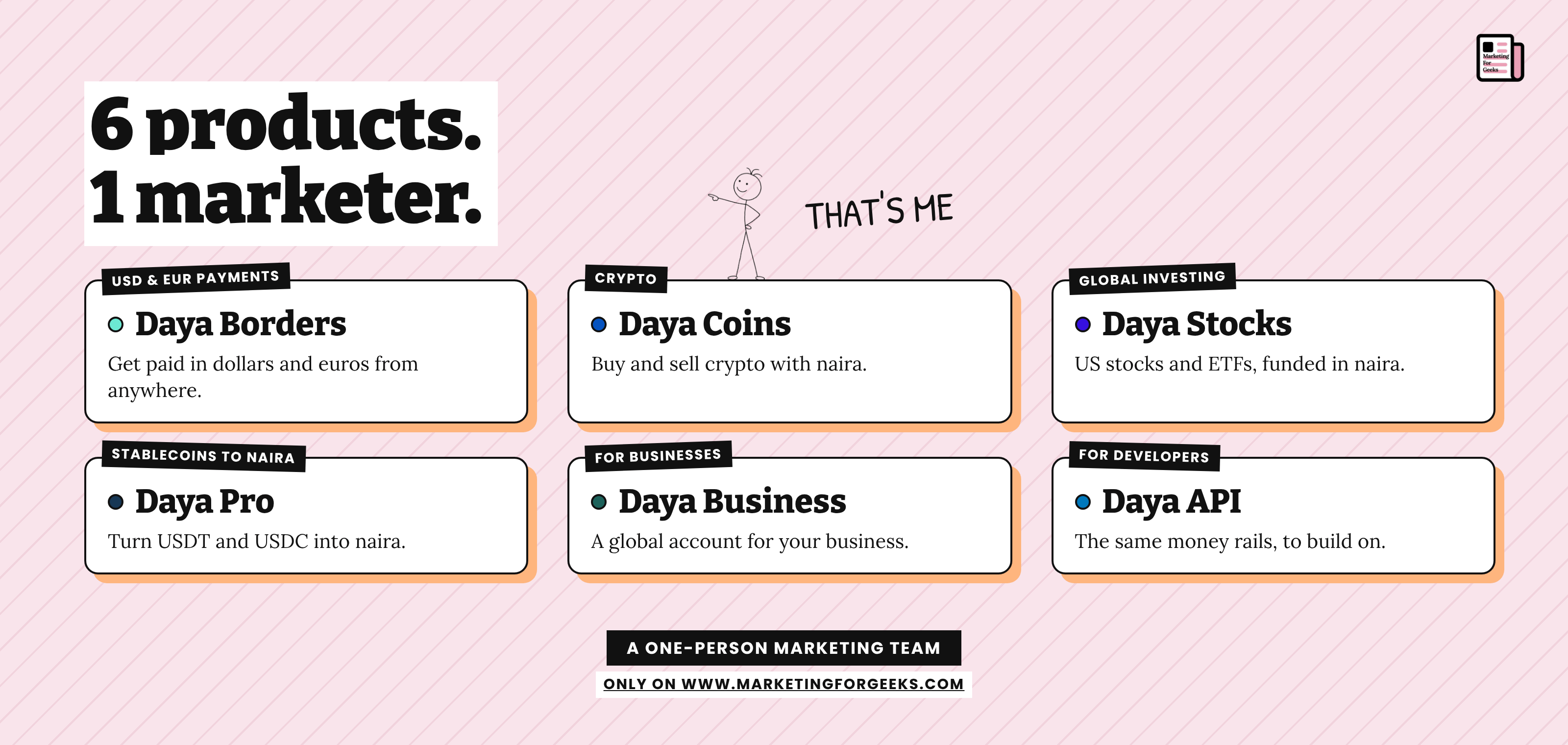
Being the solo marketer at a company with 6 products would have been completely unthinkable to me 6 months ago. Especially given my ADHD.
But I am actually doing some of the best work of my career at Daya and I do not feel near my limit.
So, for today’s issue, I am breaking down how I’ve run Daya’s marketing so far as a solo marketer with the help of AI tools (Claude primarily).
What To Expect:
Owning the company website as a non-developer
Building my dream blog
Live rates: turning our main marketing claim into proof
Designing without being a designer
How I decide what an agent can do without me
Running my tools from inside Claude
Marketer with AI vs non-marketer with AI
There is (or should be) a difference between a marketer using AI for marketing and a non-marketer using AI for marketing.
The difference rests in the approach. I don’t tell Claude to write website copy or ad copy in a vacuum. I have it follow the same process I would have followed myself. My goal with AI is to do that process faster or better.
It’s not about long prompts. I don’t follow any of the popular prompt engineering frameworks (COSTAR, RTF, RACE).
Instead, I focus on context and process.
For context, I make sure Claude has access to all the information it needs to succeed. I have clear project docs in Claude, and my sessions have a standing instruction to update the memory and docs when things change.
If it needs extra internal context, I tell it where to check. Slack, my email, meeting notes, my Drive, specific documents.
Aside from context about the product, I have Claude build up context on the topic or task itself.
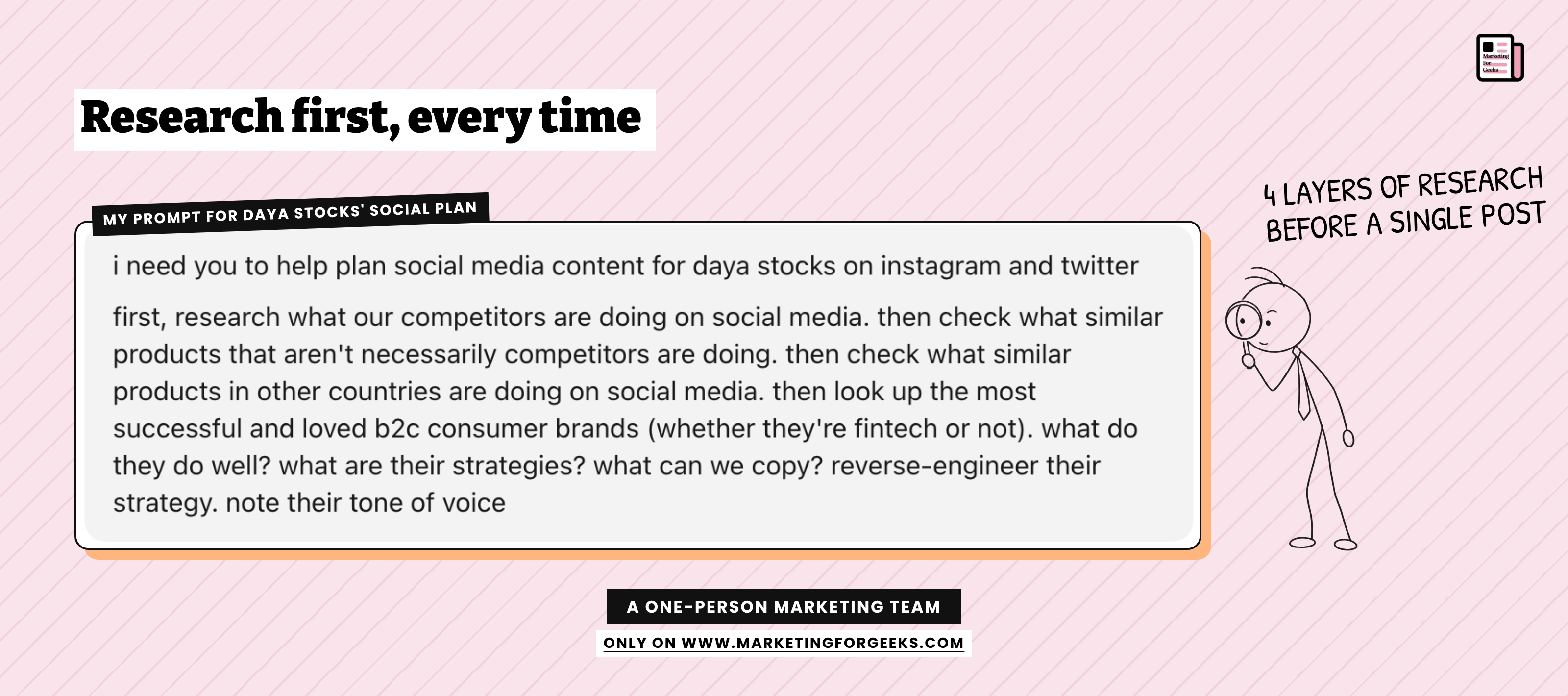
For example, when I drafted the social media plan for our products, I asked Claude to do extensive research. What our competitors do on social media. What similar companies in other markets do. What successful (and failed) consumer and business products get right or wrong. Buyer psychology.
The agent writes down what it learns, and that becomes the foundation for everything it makes after.
Next is process. I follow the same process I would typically follow myself. If I would normally write website copy by working through a specific framework, the AI does that too.
For example, when Claude and I started on Daya Borders’ messaging and positioning, it did a shoddy first job. So I walked it back. I gave Claude the worksheet I typically use for messaging & positioning exercises. It worked through the same steps and returned a significantly improved result.
It helps that pre-AI, I thought in frameworks often. So I simply hand those frameworks to AI to define its approach to the task.
When this works, some things get faster, some get better, and some get both. Here’s what that has looked like at Daya so far.
📣Tweet this.
I asked engineering for help. The CEO gave me the code instead.
In my first week, I asked engineering to help set up Google Analytics on our website.
Usually, the way that goes is — you write instructions, an engineer picks it up when they’re free, and you wait. Depending on the team, it can take days or weeks.
At Daya, the answer I got was access to the website’s code for me to do it myself.
I’d used Claude Code before, but only for my personal website.
By day 8 at Daya, I’d shipped my first change to the website. I have now spent ~15 weeks at Daya. In that time, I have pushed 71 changes (PRs) live to the site.
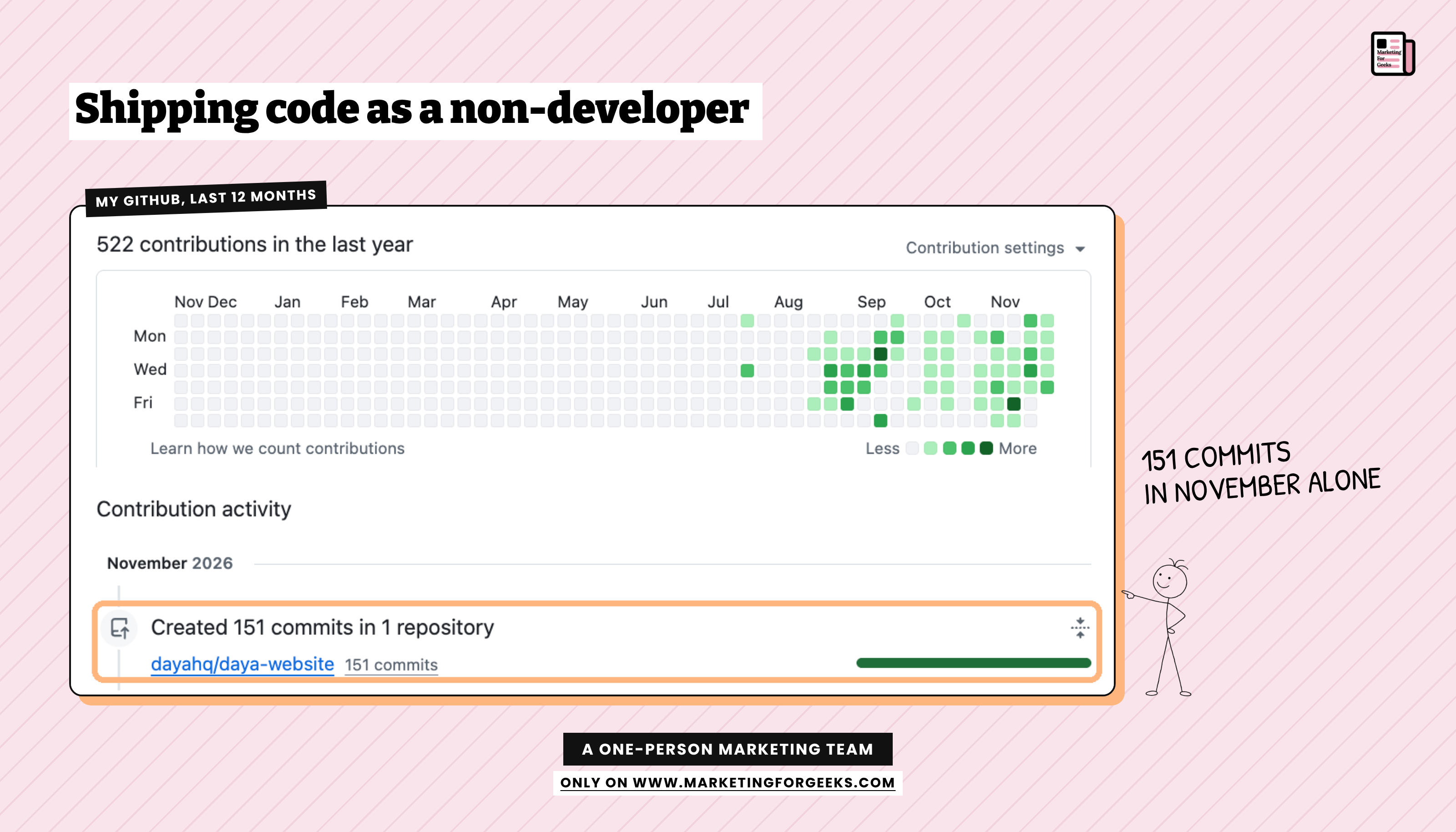
Here’s some of what that covers:
Homepage improvements: Copy, design, and structure changes on the homepage.
Product pages: For 4 products, with live rates and other data pulled via APIs
The blog: built from scratch, plugged into Sanity CMS
Campaign pages: Feature landing pages, fee pages, campaign pages, etc.
Measurement: analytics, ad pixels, a cookie consent banner, and every app install from the website credited to whatever sent the visitor.
Search and AI search: Implementing technical SEO fixes, adding the basics that Google needs.
Analytics was a case of AI moving work faster. I didn’t need to wait on anyone to deploy analytics.
In the case of the blog, it was both better and faster. I’ll explain more on that later.
First, let’s get into how I ensure I don’t ship rubbish to the website.
Who checks my work
Peer reviews are a foundational concept in engineering. When an engineer writes code, they make a pull request for another engineer to review.
It’s the same for my code changes at Daya. But in Daya’s case, we have multiple AI reviewer bots that understand our codebase as well as business and product context.
So I don’t need to wait on engineers to review my PRs either; I just tag one of our bots to do it.
I understand why PR reviews are so critical in engineering, now more than ever. The reviews have saved my butt many, many times.
Like when I almost shipped the wrong rate for our rate calculator (off by 1%). Or when I made a product claim that the bot pointed out was only half true. Or when a change I made would have credited app installs to the wrong page.
Shipping things before they look great
When you’re one person covering 6 products, you’re always asking how important something is right now.
How much does a polished page matter compared with getting the ad live, or the email out?
So I think in MVPs. I ship first versions I know could look better, because I need them live. And then I improve them later on.
Our first Daya Coins page was exactly that. I designed it with Claude, and I knew it wasn’t the final version. But people were already searching for Daya Coins, and I needed them to have somewhere to land.
Fast is my default now. I have an idea and spin up a landing page for it within 2 hours. Once something exists, it’s easier to make it better and build it to the quality you need.
Building my dream blog
Here’s what I meant by AI making things better.
If engineering builds you a blog, you write very specific instructions and end up with a regular blog. That’s because a blog isn’t a serious engineering project. Nobody spends a sprint on it.
If AI didn’t exist, most of the blog features I built wouldn’t exist either. Not because they were impossible to build. But because I wouldn’t be able to bother engineering with half of what I wanted.
Even if I had a dedicated marketing engineer, I’m sure they’d ask why I needed all of it and try to cut it down.
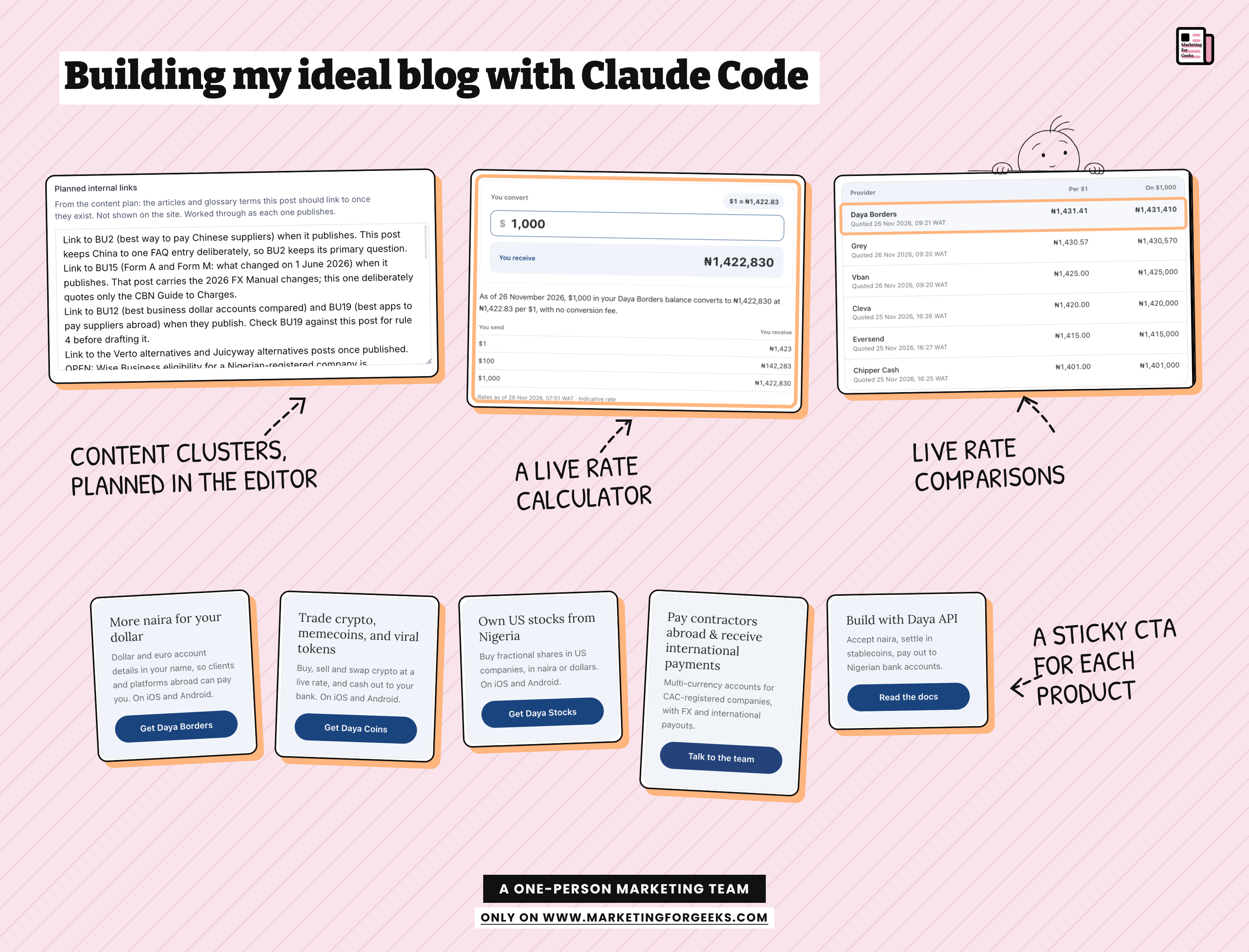
But I was building it myself, so I built the blog I actually wanted as a marketer (with Sanity CMS as the backend):
Content clusters inside the editor. I plan the blog inside the blog. Each post records which future articles will link to it, and the agent that writes articles reads that.
Live rate comparisons inside articles. If we’re comparing ourselves to other apps, we show each one’s live rates. Competitors are grouped by product, so a post about Daya Pro only offers Daya Pro’s competitors.
A sticky CTA. Readers don’t have to reach the end of a post to see how to get the product. There’s a sticky CTA that they see throughout the article.
Different calls to action per product. The sticky CTA is configurable by product. So I can match articles to the best Daya product to promote alongside it.
Easy sharing. Every section heading has a copy link button, and the share buttons fill in the post text for you.
It took 1 to 2 days for me to push live, and only that long because of review back and forth.
How the blog works
The posts on Daya’s blog might be attributed to me, but I didn’t write them.
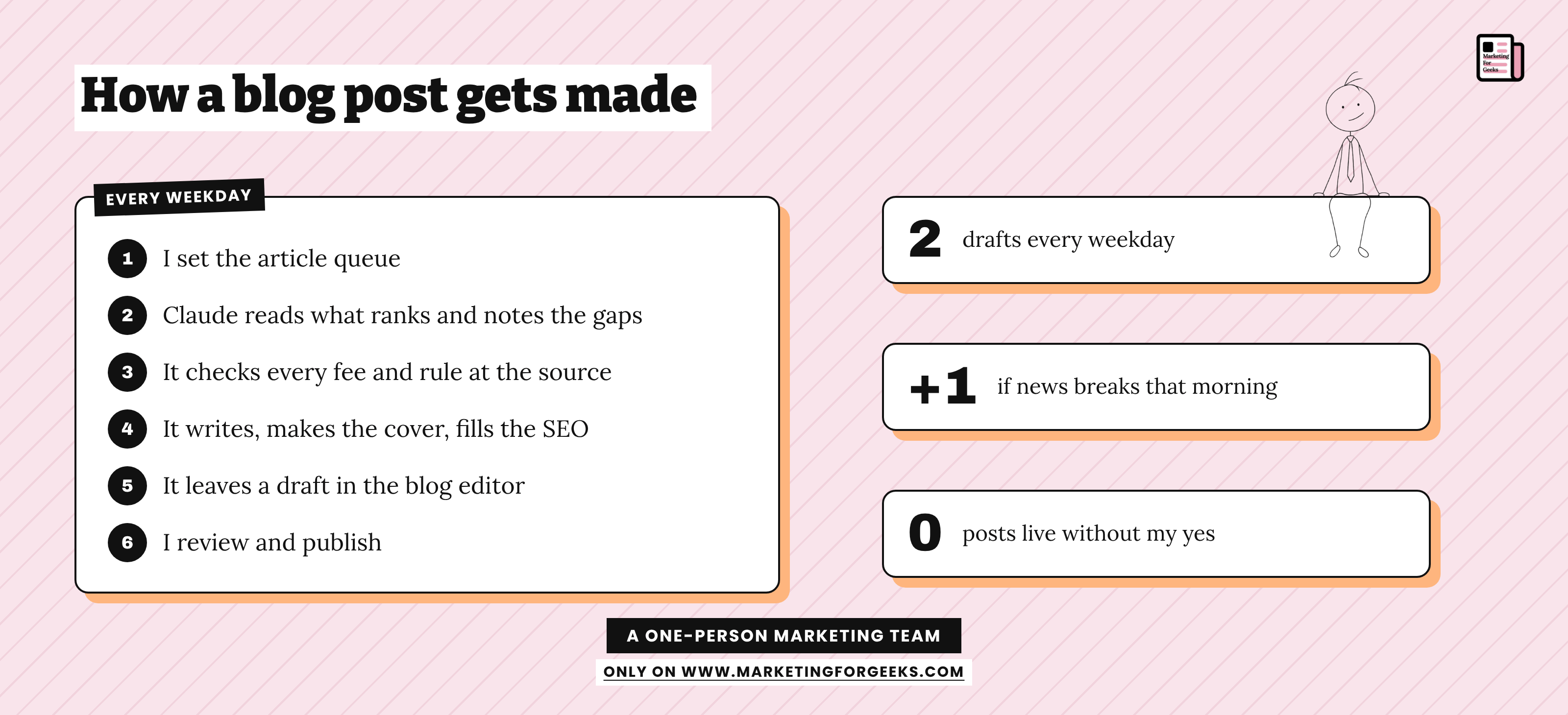
Every weekday, an agent writes 2 articles and leaves them as drafts for me. It pulls from a preset article queue I defined for it.
The agent reads what’s already ranking for the search and notes what those pages miss. It checks every fee and rule against the original source that day, so competitor fees come from the competitor’s own fees page, and regulation comes from the actual CBN circular. It writes the article, makes the cover, and fills in the SEO title, description, FAQ and sources.
If some time-sensitive news breaks that morning, it turns that into a third article for the day.
I’m not proud of the article quality yet. For the blog, I prioritised volume (initially) over deep quality, for three reasons:
I wanted a quick win: People say SEO is a long game, and it is. But it has always given me quick wins, and when I join a new company, I always go for a quick win first.
Trust: Daya is a new brand. I didn’t want someone to see one of our ads, search our name and find nothing. I wanted us to already be everywhere when people met us.
Breadth: There are 6 Daya products and only one blog (for now). So the blog had a wide range of topics to cover, which it needed to catch up to.
I’ll take this moment to espouse a view I already shared on Twitter earlier this year.
SEO is not dead.
And even if SEO happened to be battered and bruised everywhere, in Nigeria, it is alive and healthy and kicking.
Because SEO in Nigeria still isn’t saturated.
One morning, less than a month after the blog was live, I published an article around a high-intent competitor keyword. By afternoon, the article was #1 on Google and cited in Google’s AI overview.
Daya’s 3-month-old blog is being picked up by ChatGPT when people ask about financial tools and infrastructure for the various use cases we cover.
8% of Daya Borders users in the past week said they found us through an AI recommendation. And our blog actually acquires paying users.
My SEO strategy is simple, and AI hasn’t changed it.
I target high-intent low-competition keywords. Typically, that’s people at the bottom of the funnel, trying to make a decision between competitors.
I churn out multiple comparison articles (“Spenda vs Breet”, “Grey alternatives”, “best app to receive dollars in Nigeria”) and then slot our product in as one of the answers to the question.
Someone searching “Grey alternatives” is at the bottom of the funnel. They’re ready to switch, or ready to choose. They just need help making the call. Fewer people search it than a general topic, but fewer companies are competing for it too.
It’s the same strategy I used 4 years ago, before ChatGPT and Claude and AI overviews. I say that to show that “GEO” isn’t a new discipline, at least not in the way or at the scale people claim.
By and large, the same strategies that work for SEO also work for “GEO”.
📣Tweet this.
Live rates: turning our main marketing claim into proof
On the Daya Borders landing page, you can see a live rate comparison. It shows how many naira you’d get for your dollars on Daya Borders next to several competitors, at the same moment, with the source of every number.
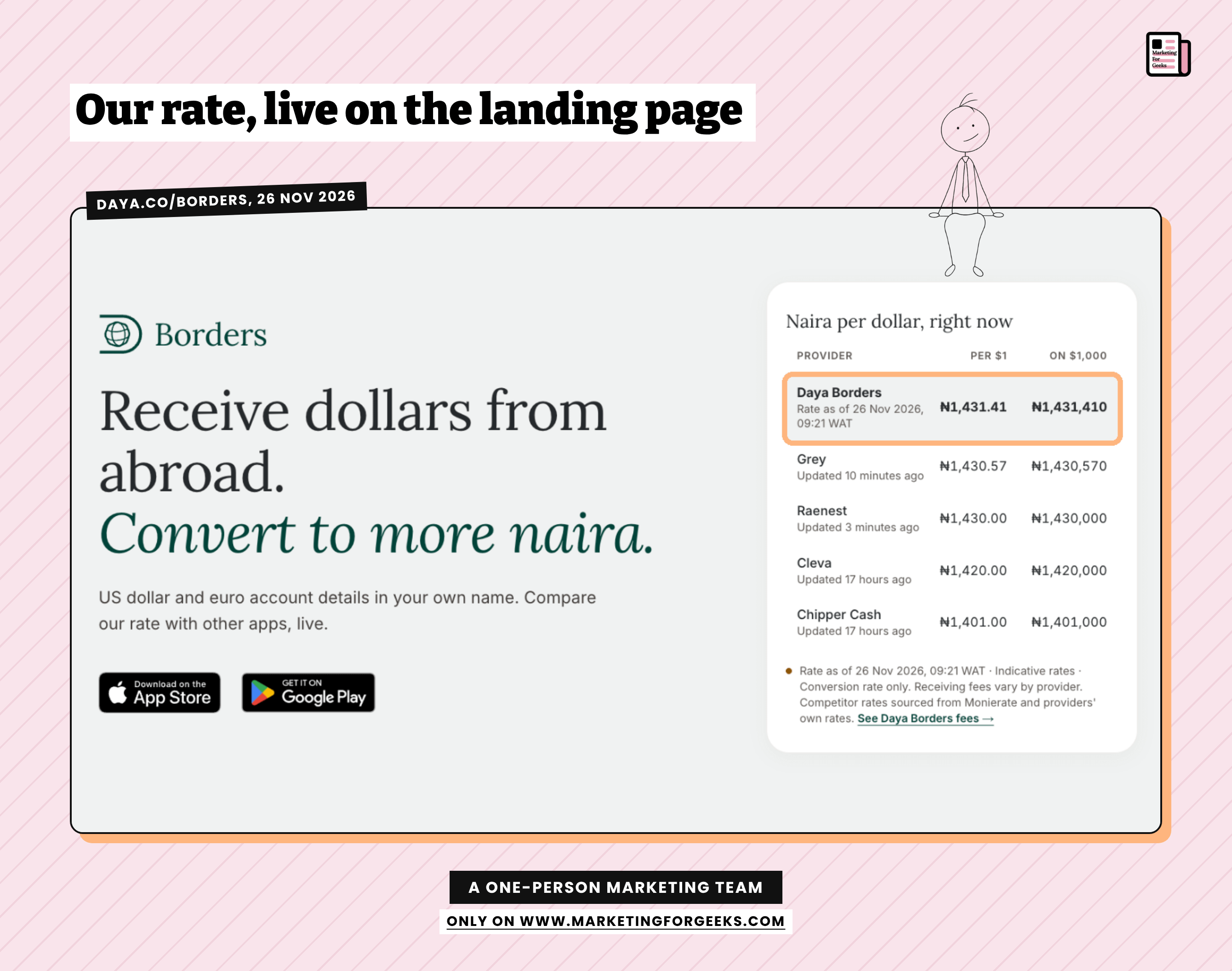
I built it myself with Claude Code.
In my first week at Daya, I had a call with someone from every product team. I asked each of them what makes Daya better than its competitors. Almost everyone said the same thing: our rates. So I checked competitor apps myself, and it was true.
But “we have the best rates” means nothing. Anyone can say it. It’s also the kind of claim that gets you in trouble, because superlative claims people can’t check are exactly what regulators look for in comparison ads.
I asked Claude Code to fetch our live rates from our own rate feed. And then I found a vendor that listed rates from our competitors via their API.
These data points formed the foundation of our messaging, product page, social posts, and paid ads.
Without Claude Code, this would have been a table I updated by hand, if it existed at all. This one was a case of AI helping me do work better.
The post that publishes itself
Every morning, our website freezes that morning’s rates and draws them as a bar chart. At 9am, an agent takes this image and posts it to X and as an Instagram Story from Daya Borders’ accounts.
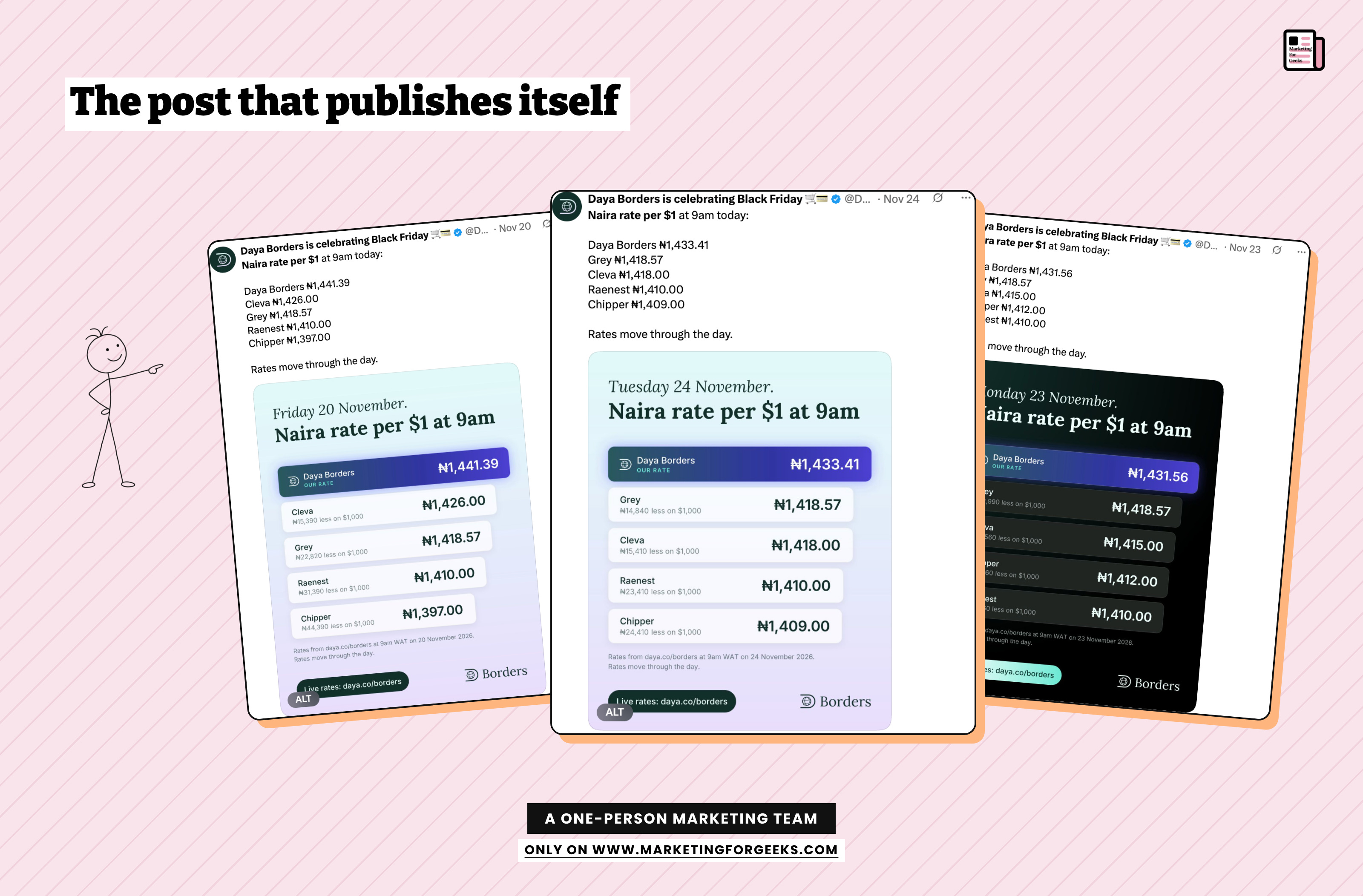
I built it on the back of the live rates work, and it goes out with no input from me.
There’s one rule I added. Every comparison only shows while Daya Borders actually pays the most. If we’re behind on a given morning, the comparison on our site hides itself and the agent posts nothing.
The comparison exists to prove our positioning. If it shows us behind, the comparison and the message don’t match, and nothing good comes from that.
Ads, from research to ads manager
Once I had the live rates, I wanted to use them in ads. But running ads for several products, across Meta and X, is close to a full-time job on its own. So Claude does most of the legwork.
Every ad starts with research. My first prompt asks Claude to:
Check the ad libraries to see what our competitors are running, and what similar companies in other markets are running.
Research the best principles for advertising, ad copywriting and designing for ads.
Read our own docs: the features we offer, what makes us different, and how we’re positioned in the market.
That research becomes its foundation. Then it ties everything together into ad angles and big ideas, the storytelling routes we could take, and presents them for me to choose from.
I pick one. Then it makes the creative and puts the ad into the right ads manager.
Claude builds the campaigns in the chat through the various ad manager connectors (MCPs) and then leaves them for me to review.
Reviewing is extra important here because most of the ad managers do not yet have well-maintained MCPs. So they are often limited or break things partway.


Once the ads look good to go, I publish them. And I check in on the campaigns, have Claude update the rate images to show fresher rates, and make small tweaks as the campaign goes.
Of all the marketing work I do at Daya, my paid ads workflow is probably the most manual.
AI has made my ads faster to make. It hasn’t yet made them better to run.
For my next trick, I want to create an agent that automatically freshens the creatives, makes new sets, reviews campaign data, and makes decisions on which ads to turn off or put more budget behind based on the data it sees.
Designing without being a designer
Just as I am a one-person marketing team, Daya has a one-person design machine. Despite his immense talent, he is only human. Which means he can only juggle so much.
To speed up my work, I do most of the designs myself with Claude (and in some cases, ChatGPT). Later, the product designer reviews and improves.
Early on, I made Daya Borders designs with Claude on my own, because it was faster. Some of them came out off-brand. So when our designer had time, he turned his knowledge of the brand into a Claude skill: a design guide for Daya Borders that the rest of us now use. I brought the faster. His skill brought the better.
With my context and that skill, Claude knows how to put a design together in a way that makes sense. It can even have fun with it.
But it’s terrible at illustrations and image generation.
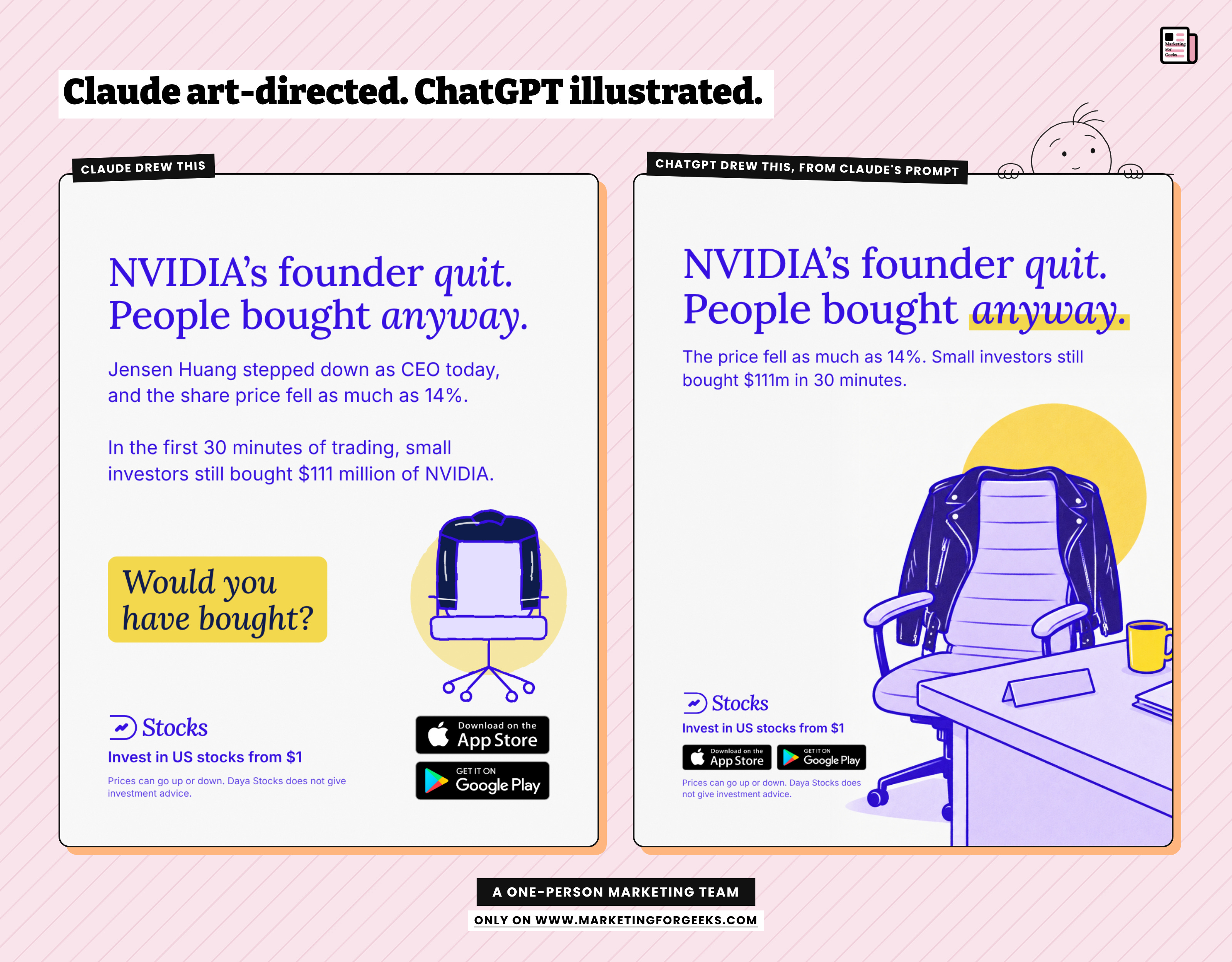
So I’ve turned Claude into an art director. It decides what the design should look like, then writes me a very specific prompt for exactly the image it needs.
I give that prompt to ChatGPT, bring the required illustration or photograph back, and Claude builds the design around it.
I’ve also had some fun using Claude for motion graphic videos, like the one I used to announce our dark mode feature.
Same tool, different results
Using AI doesn’t turn you into a designer. Our Black Friday deals hub shows this best.
I built the first version of the hub with Claude and pushed it live, because I needed it live. Then our designer had time to work on it. He designed his version with Claude too. I downloaded it, made some copy edits, and updated the page with his design.


We used the same tool. His looks far better, because he knows design the way I know marketing.
It’s the point I made at the start, from the other side. In marketing, my knowledge is what makes Claude’s work good. In design, Claude mostly makes me faster. So for design, I go for faster, and when our designer has time, he makes it better.
How I decide what an agent can do without me
With so many irons in the fire, the most obvious concern would be about things falling through the cracks.
Of course, I could manually review each agent’s output, but because I am a one-person marketing team, that’s simply not realistic.
So I use three factors to decide what agents can do without me:
How time-sensitive is it? The social media rate comparison has to go out at 9am every weekday. If I had to review it first, I’d be relying on myself to be early every single morning. Unlikely.
How much changes from day to day? When only one thing changes, it’s easy to control what the agent produces.
The rate post is the same post every day, except the numbers. So it runs on its own.
But a blog post changes in every way at once: the topic, the title, the cover, the description, the writing, sometimes the tone. So it needs a review.How bad would a mistake be? The more a mistake would cost us, and the longer it could stay up before anyone noticed, the more I want to see the work before it goes out.
📣Tweet this.
My agents
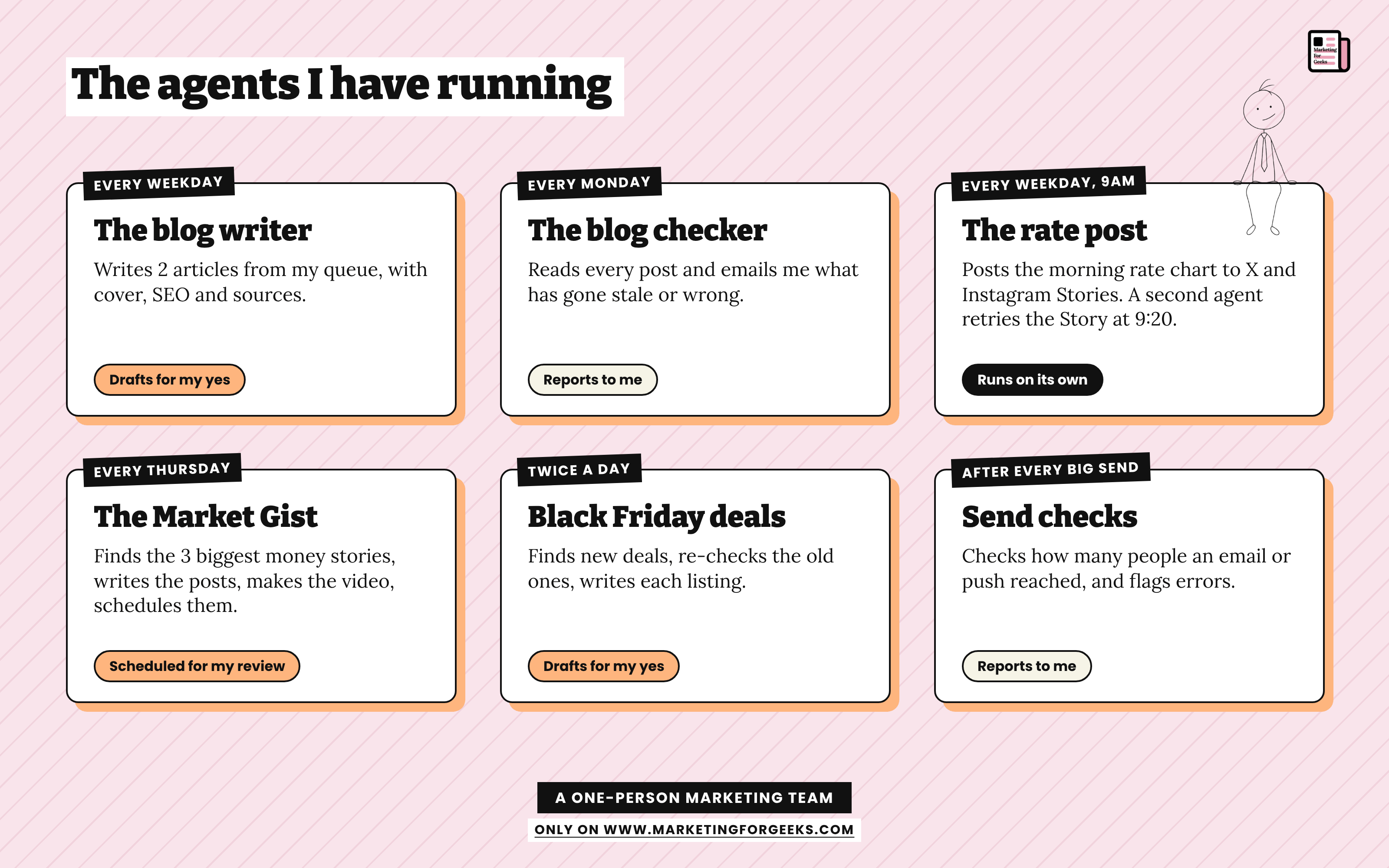
Here are the agents running for me right now:
The blog writer. Every weekday, it writes 2 articles from my queue and leaves them as drafts for me to publish.
The blog checker. Every Monday, it reads every post on the blog and emails me what’s gone stale or wrong, sorted by urgency.
The rate post. The 9am rate post from earlier. A second agent checks at 9:20am whether the Instagram Story actually went out, and tries once more if it didn’t.
The Market Gist. Every Thursday, it finds the week’s 3 biggest money stories about companies Nigerians know, writes the posts, makes the video and schedules them in Buffer for Daya Stocks’ socials.
The Black Friday deals agent. I set this up for Daya Borders’ Black Friday campaign, to fill a deals hub I built. Twice a day, it searches for new deals, re-checks the ones already listed, writes each listing and saves it as a draft for me to publish. I set a target of 250 deals, and we’re at 200+ so far.
Send checks. After a big email or push goes out, an agent checks how many people it actually reached and tells me if there were any errors.
If I tried to keep all of these tasks up by hand, I’d forget, or I’d find out late.
I’m working across multiple financial products, each with its own niche, which means their trends and big news are different.
One person can’t stay on top of all of them every day. Agents can.
I barely open my tools any more
Claude is connected to most of our marketing tools: Customer.io, AppsFlyer, Buffer, Sanity, various ad managers, Slack, Gmail, Google Drive, and my browser.
So most days, I don’t open the tools directly. I do most of my work inside Claude, directing it.
When I write an email, I don’t go into Customer.io to build it. I tell Claude to put it in Customer.io and schedule it. If I want to see it first, I ask Claude to send a test email to my inbox and a test push to my phone. None of this requires me to actually open Customer.io.
When I draft social content with Claude, I ask it to schedule it in Buffer. If I need to shift posts around, I just say so. If I need to edit an existing scheduled post, I tell Claude to do it.
Every Monday, I present a marketing report during all-hands. For this report, Claude pulls the week’s numbers from multiple sources. Google Analytics, Google Search Console, AppsFlyer, Bing Webmaster, Human Behavior, Customer.io, respective ad manager accounts, and so on.
Then it pulls context on work done from Slack, meeting notes, my email, and my Drive.
Up next, I want to build a live dashboard that holds these key metrics, pulling them from multiple sources into one central marketing admin dashboard.
The bad and the ugly
Of course, it’s not all good. AI isn’t a magic wand. And even if it were, it would come at a cost.
For me, it already does.
The biggest downside for me is the switching costs. I have so many agents and so many chats going that I’m constantly switching between them. And it means sometimes things fall through the cracks.
But that happened pre-AI too. When you’re a solo marketer at an early-stage company, you have to choose your battles. You have to be okay with some things not being at the quality they’d otherwise be.
And being able to do more doesn’t mean you should. You’re still the one directing all of it. If you take on too much at once, things slip (whether in quality or in accuracy) because you’re stretched thin.
Our blog is the clearest example. AI let me publish fast, and the volume did its job. But when I finally sat down and read it properly, the writing was hard to read and full of AI tells.
It all came from one root problem: Claude didn’t have a proper editorial guide. So I’m now auditing the whole blog and building a guide the agent writes from. Faster came first. Better is next.
Other times, better came first. The live rate comparison started as a way to prove our claim instead of just making it. Only later did it become a post that goes out every morning without me. Better, then faster.
In the end, my goal is to achieve both, whichever order they may come in.
I’d love to hear how you’re using AI in marketing. And if you need something to convince your management to invest in AI tooling for you, just send them this article.
TL;DR (Too Long, Didn’t Read): AI won’t make you a better marketer on its own. Give it the context and process you’d use yourself, let agents run the repeatable work, and keep your yes on anything that would be costly to get wrong.
📣Tweet this.
Did you enjoy reading this? Give it a ❤️ and let me know in the comments section.
Even better, share this with someone. If they subscribe, you get referral rewards, like free templates.
Want to do more than read MFG?
Join MFG’s WhatsApp community to partake in marketing discussions. The community includes 800+ Nigerian marketers across all levels sharing ideas, feedback, and resources.
Take advantage of discounts from MFG’s partners
Treford’s live bootcamps - 15% discount - Code MFG
Algrowithm's growth engineering trainings - 15% discount - Code MFG
The Growth Handbook by Binjo Adeniran - 20% discount - Code MFG
What I’m Reading
How Many Marketing Titles Can I Have In My Lifetime? — Content Engineer, Narrative Engineer, Head of Taste, Brand Engineer; I just wanna get paid, puhleaseeee.
How I manage my time in an unpredictable environment — second part of a three-part series exploring ways to manage your time, to help you protect your creative hours, stay focused, avoid overcommitting to projects, and live a less frazzled life.
Stop asking users what they want — Ask these questions instead (with examples from real user interviews)
How To Create Urgency When Buyers Are Fine With “Good Enough”
Dogfoodmaxxing 📈 — Show how you use your product YOURSELF. It’s probably the most convincing marketing win you can get.