
💡MFG #16: The 7 Principles of Persuasion, B2B Personas, and more.
How to use the 7 principles of persuasion to improve conversion, the 3 types of B2B personas you need to create, and how to use compounding strategies to create MoM growth.


Hi there.
Welcome to the 103 new subscribers who joined Marketing For Geeks since the last issue. Big thanks to everyone who shares MFG with their network.
Every month, I share 1 interesting thing, 3 actionable marketing insights that have helped me do better product marketing, and 5 pieces of marketing that caught my eye.
ICYMI: In my last issue, I launched Funnel Vision and spoke with Daniel Orubo of Piggyvest about how he built Piggyvest’s content engine.

Funnel Vision will come once monthly, so you can expect the next one to drop in 2 weeks. P.S. I interviewed for the next Funnel Vision weeks ago, and it’s about growth experiments at Risevest😉. So, subscribe (if you haven’t) so you don’t miss it.
In today’s issue, I discuss the 7 Principles of Persuasion, B2B persona types, compounding strategies, and more.
It’s a long one. Let's dive in!
🔑1 Interesting Thing
Today I’d like to discuss one of my top frameworks; Cialdini’s 7 Principles of Persuasion. Robert Cialdini created the principles 30 years ago, and they’re as relevant today as they were then. Because while times might change, people remain the same.
Let’s cut the long story and dive into the principles:
Reciprocity
“Do as you would be done by.” “Treat others as you would like to be treated.” “Give something to get something”
We’ve all heard different variations of the principle of reciprocity. It’s a universal truth. Give people something and they feel obligated to give you something in return.Scarcity
This is another common principle. When something seems scarce—whether it's a limited-time offer or exclusive access—it suddenly becomes more desirable. This principle taps into our FOMO and makes us value something even more because we know others can't easily have it.Authority:
We tend to listen to people who have authority. Whether it's job titles, certifications, degrees, or a company's reputation, these signs of authority can help reassure customers. There are two ways to leverage authority.Focus on your authority: Has your product been in existence for decades? Does your team consist of subject matter experts? Whatever authority you have, highlight it as clearly as possible.
Leverage other people’s authority: Another approach is to get endorsements from the people or companies whose authority your audience respects. Just ensure the authority is relevant to the audience and product in question.
Commitment & Consistency:
People don't want to be seen as unreliable so they try to stay consistent with their actions. This makes it hard for them to make big commitments sometimes. To use this principle, ask your audience to commit to small actions first. These low-stake commitments build up loyalty and add up to a bigger investment in your product.Liking:
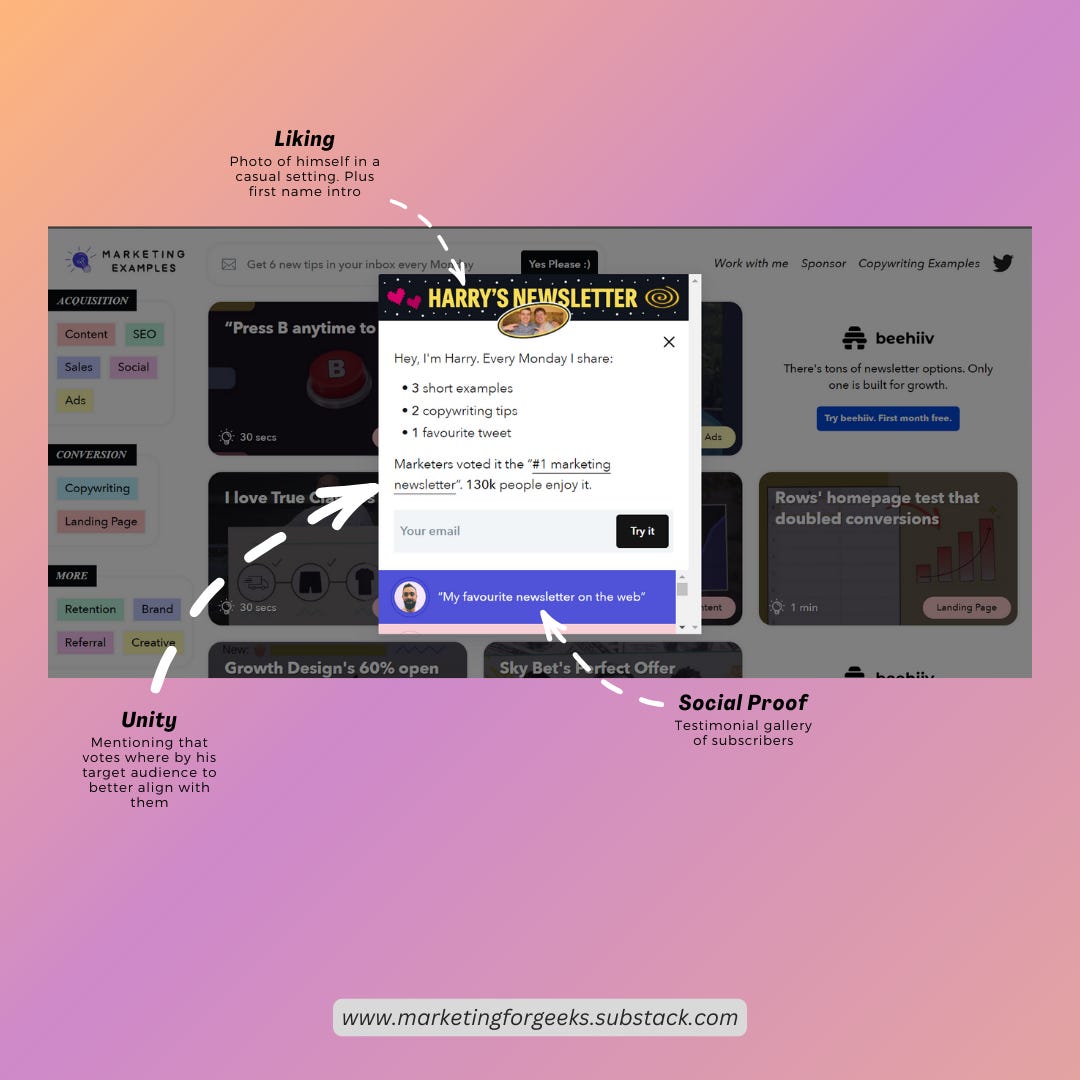
Humans are more interested in people, things, or topics that they like. So, you need to make yourself, your brand, or your product likeable. Use personable content, language, or people that they can relate to. It’s why concepts like founder marketing, employee advocacy, and brand voice exist.Social Proof:
There’s hardly any marketer who hasn’t heard about the principle of social proof. People listen to other people’s opinions and they buy into what others are doing. So, with social proof, you show prospects that other people like or use your product.Unity:
This is the 7th principle, added by Cialdini in 2016. If your target customers feel included in what you do, they are more likely to participate. People like to belong to something (or to feel like they do). This is why brands leverage shared identities in marketing, like race, sex, and nationality. E.g. “Made in Nigeria For Nigerians” “Women-Centered” “Black-owned organization” etc.
For Unity to work, you need to deeply understand who your ideal customer is, and who it isn’t. Otherwise, you risk excluding or offending your customers to appease non-customers. To help with this, you can create negative personas.

How To Use The Principles

This barely scratches the surface, so in future issues, I will write more deeply about each principle of persuasion.
TL;DR (Too Long, Didn’t Read): If you want to improve your conversion rate, try using Cialdini’s 7 principles of persuasion. P.S. You probably already know at least 2 of them.
📣Tweet this.
A Little Game
I use every single one of Cialdini’s principles in Marketing For Geeks. If you can mention 3 out of 7 of them, I’ll share 1 out of these 3 resources with you (you pick which):
My marketing plan template
My marketing channels checklist
My experimentation tracking template
If you can guess all 7? I’ll send all 3 resources your way.
How do you play?
Just make a post on LinkedIn or Twitter mentioning the principles you’ve caught me using in Marketing For Geeks and how I used them. Then tag me and Marketing For Geeks.
P.S. The prizes are only valid till I publish the next issue of MFG. Once I publish the next issue, you will only be able to access the free resources by referring new subscribers to Marketing For Geeks.

This is not a paid ad. This is a recommendation from me because I think this handbook is a must-read.
Binjo Adeniran spent months speaking to marketing & product leaders (from Peace Itimi to David Adeleke) at Nigeria’s top fintech companies and compiled it into a handbook. It’s an amazing read whether you work in fintech or not. Contains everything from community building, storytelling, performance marketing, sales, and user trust.
Get 20% off the book when you use the code LADEGROWTH.
💭3 Insights
#1. Decision-makers aren’t the only B2B persona you need to consider.
When it comes to B2B products, decision-makers are very important personas, but they aren’t the only ones you need to consider. In most B2B cases, the people with decision-making power are not the ones experiencing the problem your product solves. They won’t be the ones using the product or setting it up.
That’s why when you create personas, you should include personas for the decision-makers, the champions, and the implementers.

The decision-maker is the person with the power to say yes or no to a new product. These are the senior executives who have the final say on what the company uses, e.g. the CMOs, CFOs, CEOs, Heads of Department, etc. They care about ROI— Is the investment into your product worth it?
On the other hand, the champion is the person who feels the problem deeply. They face the problem every day and will be excited by the idea of your product coming in to solve their problem. But they often don’t have any buying power; they need the approval of the decision-maker.
The implementer typically has absolutely no stake in the product. They don’t feel the problem and they don’t care about it. An example is an engineer who has to help set up Google Tag Manager or Customer.io for the marketing team. All the implementer cares about is how easy it is to set up and how much time it would take.
So what do you do?
You need to empower the champion with the resources they need to advocate your product. Give them the pricing pages, sales decks, and comparison pages that they need to convince the decision-makers to say yes. You can further incentivize champions by offering them rewards, for example, for bringing their company on board.
For the implementer, make sure you have clear documentation that makes their work (implementing the product) easy. Don’t bother selling to them.
TL;DR: When creating your B2B personas, include champions who’ll advocate your product because they feel the point; decision-makers who’ll pay for your product; and implementers who’ll integrate your product.
📣Tweet this.
#2. MoM growth is easier when you set up compounding growth strategies.
It can feel really great when you have huge spikes in growth, but if you can’t sustain that spike (or at least retain a portion of it), it might be difficult to achieve steady month-on-month growth. That’s where compounding strategies and growth loops come in.
This doesn’t mean abandoning one-off campaigns; it means setting up loops and funnels that help you ensure that campaigns lead to more sustainable growth. That way, your charts don’t go back to red after a sudden spike.
Here are some examples of compounding growth strategies to help you achieve MoM growth:
Setting up retargeting campaigns after traffic spikes.
Creating referral programs to increase your viral coefficient.
Setting up loyalty programs to incentivize repeated actions.
Creating evergreen content to bring consistent traffic.
TL;DR: By implementing compounding growth strategies like retargeting, referrals, loyalty programs, and evergreen content, you can ensure sustained growth even after initial spikes in traffic or engagement.
📣Tweet this.
#3. When competitors fail, it’s time to swoop in.
I’ve spoken a lot about the importance of monitoring competitors so you know how/when to steal customers from them. I even shared my competitor research template (which I updated recently by the way).
So you can probably already tell I’m big on competitor research and using insights from that research in marketing.
When Disha, a mini-website builder for creators, paused operations this year, I expected competitors like Fidia, Mainstack, and Selar to swoop in and steal confused customers. That didn’t happen, which is what prompted me to share this insight. I’m a Disha user myself and was surprised that Googling “Disha paused” “Disha shut down” “Disha alternatives” “what to do as Disha shuts down” didn’t bring any results from competitors.
Last year, when Google Optimize shut down, users didn’t have to go far to find alternatives. That’s because competitors swooped in with great communication targeting Google Optimize users (+ Google itself recommended 3 of those competitors as alternatives).

There’s no better time to steal customers from a competitor than when they fail, make a mistake, or are in the news negatively. Searches for their brand keywords will increase (from people trying to get more info about what’s happening) and users are more primed for alternatives (because of dissatisfaction).
That’s when you target relevant competitor keywords, create transition/migration plans, and ramp up your messaging, just like Optimizely, VWO, and ABTesty did when Google Optimize shut down.
TL;DR: When competitors fail, seize your opportunity. Be ready to swoop in with targeted messaging, transition plans, and comparison pages to capture dissatisfied customers searching for alternatives.
📣Tweet this.
⚡5 Pieces of Marketing
In the spirit of today’s interesting thing, I’m showing how different products leverage some principles of persuasion in their websites.
#1. Notion’s Home Page👍🏽


#2. Refactoring UI’s Landing Page👍🏽

#3. Harry’s Newsletter’s Pop-Up👍🏽
#4. Close’s Demo Booking Page👍🏽

#5. Basecamp’s Underdog Page👍🏽

#6. [BONUS] This Book’s Amazon Page👍🏽
This page uses all 7 Principles of Persuasion, just like MFG does. But I’ve left it blank. If you’re down for another little game, try spotting all 7.

What I’m Reading
The 30-60-90 Day PMM Cookbook — A guide on what product marketing is and what your first 90 days should be focused on as a newly hired product marketer. P.S. Marketing For Geeks is featured there as a top product marketing resource😊
From 0 to 10 million users in four years — How copy.ai got 40k users in 3 months and scaled to 10m in 4 years.
How / What vs. Do / Is 🤸♀️ — Forget the confusing title. This is an amazing article on the thinking that leads to the 2 types of people in teams (strategists vs doers).
How to Build an Interesting Portfolio that Gets You the Job — As someone who spent a lot of time reviewing portfolios in the last month, this addresses the top mistakes people make in their portfolios.
4 Types of Positioning for SaaS Products — Exactly as it says. 4 approaches to positioning for your SaaS product.
Did you enjoy this issue? Give it a ❤️ and let me know in the comments section.
Even better, share this with someone.
Awesome as always, Lade. Definitely playing the game.
Question. Do you always take out time to intentionally include these principles or you just catch yourself using them?